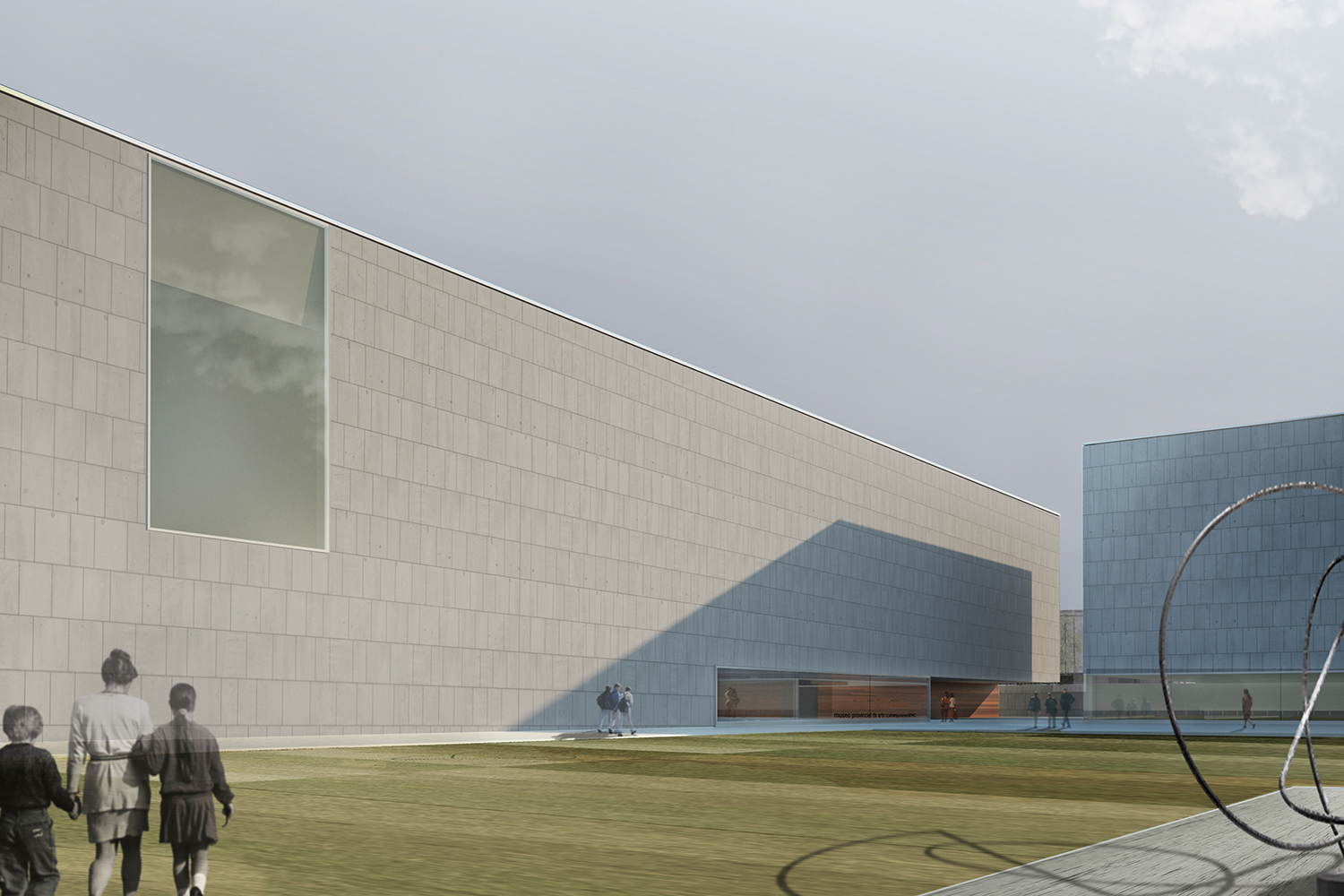
Los museos siempre han sido considerados como espacios de divulgación cultural orientados a un público selecto. Sin embargo, hoy en día, esta situación esta cambiando. Un museo es un lugar donde uno puede descubrir cosas maravillosas y al cual puede acceder toda la sociedad. Es por eso que debería contar con dependencias lúdicas y de uso más permanente: biblioteca, oficina de turismo e información, sala de conferencias/audiovisual, cafetería y actividades culturales diversas pensadas para todas las edades. Esto permitiría seguir dando vida al edificio, fuera del horario de las exposiciones.
Actualmente, el poder adaptarse a los cambios de forma rápida es imprescindible, lo mismo sucede con la arquitectura. Se pensó en un edificio simple, que permita una construcción rápida y económica, sirviéndose de los elementos que nos brinda el lugar (piedra MdP), pero fundamentalmente que logre ser un edificio flexible que pueda adaptarse a las necesidades de la sociedad futura.
La trama urbana de Mar del Plata podría ser la de cualquier ciudad de la llanura pampeana: una gran grilla trazada a cordel. Pero en este caso el emplazamiento tiene dos grandes condicionantes: uno, los accidentes geográficos con sus montes y arroyos (actualmente entubados), el otro: la inquietante presencia del mar y su sinuosa curva costera. Sin embargo, cuando uno se detiene a mirar a vuelo de pájaro la ciudad, estas alteraciones no provocaron más que pequeñas alteraciones en el modelo: manzanas trapezoidales, o algunas avenidas diagonales. Y la llegada al mar, salvo algunas excepciones que generan un parque, generalmente hace chocar la grilla contra el mismo.
El predio en el que se encontrará el museo es una clara muestra de esto, y representa el desafío de lograr un espacio intermedio entre la ciudad y el mar.
Ahora: ¿Como lograr delimitar un espacio urbano intermedio, en un vacío de cuatro manzanas, en dos de las cuales se construirán viviendas de baja escala, y en otra equipamiento urbano cuya volumetría no está aún definida? ¿Cómo ubicar un edificio de 6.000 m2 en este vacío urbano rodeado de viviendas?
La estrategia urbana de implantación es fundamental.
El proyecto consiste en la construcción de una gran placa pétrea que se eleva antes de que la grilla llegue al mar, plegando la trama urbana de manera que remate suavemente en ésta, y liberar así el espacio lindante con la costa. Esto genera un espacio cívico de escala controlada por la contundente presencia del edificio donde podrán exponerse obras escultóricas en un parque verde bajo la sombra de los árboles, como figuras que se proyectan sobre dos tipos de fondo neutro, el gris de la piedra, y el horizonte infinito del mar.
En un área de la ciudad todavía desdibujada y fraccionada, esta gran placa jerarquiza el museo, y otorga una lectura clara de dónde termina la ciudad, y dónde comienza el espacio de escala urbana mayor.
Hacia el lado de la ciudad se genera un recinto de esparcimiento y espacio de exposición de esculturas, cuya escasa altura genera un fuelle de escala doméstica entre la extensión de la ciudad y la gran placa, permitiendo una comunicación visual entre lo que pasa dentro de los límites del museo y el exterior. El edificio en si es, entonces, un gran contenedor regular.
La forma regular admite la plenitud de gran espacio único y una cantidad de subdivisiones para minimizar los espacios de exposición.
La segunda etapa se resuelve mediante la construcción de un segundo prisma exento dispuesto en forma perpendicular al primero, tomándose también de la trama. De esta manera, se remarca la delimitación noreste de la gran plaza, evidenciando la función que en la primera cumple el mismo tejido urbano existente.
El cuarto lado está difusamente limitado por la proyección del gran volumen del museo, relacionándose mediante una escala de mayor magnitud con el predio adyacente, considerando que actualmente es una plaza con árboles, continuación de la plaza de acceso. De esta manera, la disposición del lleno y el vacío en el predio, ya predispone a generar una continuidad espacial de mayor escala con el predio donde estará el futuro edificio de equipamiento, conjunto que constituirá un frente hacia el mar.
La complejidad que implica las etapas en un edificio, está resuelta no como un agregado morfológico pegado a una forma existente, sino como un completamiento de la estrategia urbana. Es por esto que la ampliación se plantea como otro edificio independiente perpendicular al primero generando y limitando este gran abra en la grilla urbana, y en cuyo ángulo se produce el acceso a ambos. Esto, además, evita inconvenientes en el uso de la primera etapa durante la construcción de la segunda. Las salas de las dos etapas serán independientes, las de la primera permanentes y las segundas temporarias. El único espacio cubierto compartido entre ambas es el acceso y el área de mantenimiento y depósitos, ubicada en el subsuelo.
El acceso público al edificio se produce desde el mar, en una secuencia en la que el usuario recorre la plaza cívica dándole la espalda, para ingresar a través de un semicubierto muy controlado, y girando para poder redescubrir el mar desde otra óptica.
El hall es un espacio pasante abierto al patio de esculturas, y es el generador funcional y arquitectónico del museo: por un lado sirve de foyer del microcine y acceso a la cafetería, y por el otro al museo propiamente, permitiendo fácilmente la separación horaria de usos.
La disposición de las circulaciones verticales permite usos alternativos o conjuntos de las salas que se encuentran en el primer piso, y miran hacia el patio de esculturas como primer lugar desde el cual comenzar el recorrido del museo.
Dos circulaciones paralelas en ambos extremos del prisma permiten darle un sentido al recorrido, sumado a que permite al espectador alcanzar una visión integra del lugar.
El acceso vehicular de las obras y de abastecimiento, está directamente relacionado con el montacargas, y se encuentra ubicado en la esquina de servicio, definida por la espalda del microcine. El montacargas une las salas de exposición, con los depósitos y talleres de mantenimiento ubicados en el subsuelo.
El concepto de las salas en el primer nivel podríamos decir que se asemeja al de una nave industrial. Se organiza a partir de una sección de grandes dimensiones, que se soporta, a modo de puente, en la mínima cantidad de apoyos, contenidos dentro del espesor murario perimetral. Estos apoyos en planta baja se multiplican, generando diferenciaciones espaciales y economía estructural donde ya no es necesario mantener grandes luces sin interrupciones.
Se crea en planta alta una sección industrial grande, neutra y útil, logrando que las salas sean un gran espacio único plausible de dividir fácilmente: grandes contenedores ciegos, iluminados cenitalmente. Una sola abertura distingue a la sala audiovisual, permitiendo que la imagen cambiante diaria del mar sea considerada como una obra de arte más de la sala.
Los espacios de circulación vertical y antesala son oscuros, generando un contraste entre los espacios que unen: la planta baja, pasante, luminosa y continua con el exterior, y las salas, abstractos espacios separados de la realidad.
Museums have always been considered spaces for cultural dissemination aimed at a select public. Today, however, this situation is changing. A museum is a place where one can discover wonderful things and one that should be accessible to society as a whole. For this reason, it should include playful and more permanent facilities: a library, a tourism and information office, a conference/audiovisual room, a cafeteria and diverse cultural activities conceived for all ages. This would allow the building to remain active beyond exhibition hours.
Today, the ability to adapt rapidly to change is essential, and the same applies to architecture. The project was conceived as a simple building, allowing for fast and economical construction, using the elements provided by the site (Mar del Plata stone), but above all seeking to become a flexible building capable of adapting to the needs of future society.
The urban fabric of Mar del Plata could be that of any city on the Pampas plain: a large grid laid out by line. In this case, however, the site is conditioned by two major factors: first, the geographical accidents with their hills and streams, now culverted; and second, the unsettling presence of the sea and its sinuous coastline. Yet, when one looks at the city from above, these alterations have produced only minor changes in the model: trapezoidal blocks or some diagonal avenues. And when the grid reaches the sea, except in a few cases where it produces a park, it generally collides with it.
The site where the museum is to be located is a clear example of this condition, and represents the challenge of creating an intermediate space between the city and the sea.
How, then, can an intermediate urban space be defined within a void of four blocks, two of which will contain low-rise housing and another an urban facility whose volume has not yet been defined? How can a 6,000 m² building be placed within this urban void surrounded by housing?
The urban strategy of implantation is fundamental.
The project consists of constructing a large stone slab that rises before the grid reaches the sea, folding the urban fabric so that it gently ends there, thus freeing the space adjacent to the coast. This creates a civic space of controlled scale, defined by the forceful presence of the building, where sculptural works may be exhibited in a green park under the shade of trees, like figures projected against two types of neutral background: the grey of the stone and the infinite horizon of the sea.
In an area of the city that is still undefined and fragmented, this large slab gives hierarchy to the museum and provides a clear reading of where the city ends and where the space of a larger urban scale begins.
Towards the city, an enclosure for leisure and sculpture exhibition is generated. Its low height creates a domestic-scale buffer between the extension of the city and the large slab, allowing visual communication between what occurs within the museum limits and the exterior. The building itself is therefore a large regular container.
The regular form allows for the fullness of a large single space and for a number of subdivisions in order to minimize exhibition spaces.
The second phase is resolved through the construction of a second freestanding prism, placed perpendicular to the first and also anchored to the grid. In this way, the northeastern limit of the large plaza is emphasized, making evident the role that, in the first phase, is fulfilled by the existing urban fabric itself.
The fourth side is diffusely limited by the projection of the museum's large volume, relating at a larger scale to the adjacent site, which is currently a tree-filled square and a continuation of the access plaza. In this way, the arrangement of solid and void on the site already predisposes a larger-scale spatial continuity with the plot where the future facility building will be located, together forming a frontage towards the sea.
The complexity involved in the phasing of a building is resolved not as a morphological addition attached to an existing form, but as the completion of the urban strategy. For this reason, the expansion is proposed as another independent building, perpendicular to the first, generating and delimiting this large opening within the urban grid, with the access to both buildings occurring at their angle. This also avoids inconveniences in the use of the first phase during the construction of the second. The exhibition rooms of the two phases will be independent: those of the first permanent, those of the second temporary. The only covered space shared by both is the access and the maintenance and storage area located in the basement.
Public access to the building occurs from the sea, in a sequence in which the visitor crosses the civic plaza with their back to it, enters through a very controlled semi-covered space, and then turns in order to rediscover the sea from another point of view.
The hall is a through-space open to the sculpture courtyard, and is the functional and architectural generator of the museum: on one side it serves as the foyer for the microcinema and access to the cafeteria, and on the other to the museum itself, easily allowing different uses to be separated by schedule.
The arrangement of the vertical circulations allows alternative or combined uses of the rooms located on the first floor, which look towards the sculpture courtyard as the first place from which to begin the museum route.
Two parallel circulations at both ends of the prism give direction to the route, while also allowing the viewer to achieve an integral vision of the place.
The vehicular access for artworks and supplies is directly related to the freight elevator, and is located at the service corner, defined by the back of the microcinema. The freight elevator connects the exhibition rooms with the storage and maintenance workshops located in the basement.
The concept of the exhibition rooms on the first level could be compared to that of an industrial nave. It is organized from a large-scale section, supported like a bridge on the minimum number of supports, contained within the thickness of the perimeter wall. On the ground floor these supports multiply, generating spatial differentiations and structural economy where large uninterrupted spans are no longer required.
On the upper floor, a large, neutral and useful industrial section is created, allowing the exhibition rooms to become a single large space that can be easily divided: large blind containers, lit from above. A single opening distinguishes the audiovisual room, allowing the daily changing image of the sea to be considered as one more work of art within the room.
The vertical circulation spaces and anterooms are dark, generating a contrast between the spaces they connect: the ground floor, through, luminous and continuous with the exterior, and the exhibition rooms, abstract spaces separated from reality.
Autores / Authors: Antonio Carrasco · Nicolás Pinto da Mota · Colaboradores / Collaborators: Eduardo Vázquez Batti · Mateo García Gutiérrez · Estanislao Gutiérrez Arranz · Nicolás Malegni · Pedro Peña y Lillo · Josefina Pozas Guzmán · Asesor iluminación / Lighting consultant: Víctor Hugo Ciotti · Asesor estructura / Structural consultant: Fernando Saludas · Asesor termomecánica / Mechanical consultant: Alejandro Blasco · Situación / Location: Mar del Plata, Buenos Aires, Argentina · Proyecto / Project: 2009 · Programa / Program: Museo Provincial de Arte Contemporáneo · Provincial Museum of Contemporary Art · Superficie primera etapa / First phase area: 6.000 m²